Early Alkali Milestones
Alkali is already being used to estimate hundreds of new projects each month.
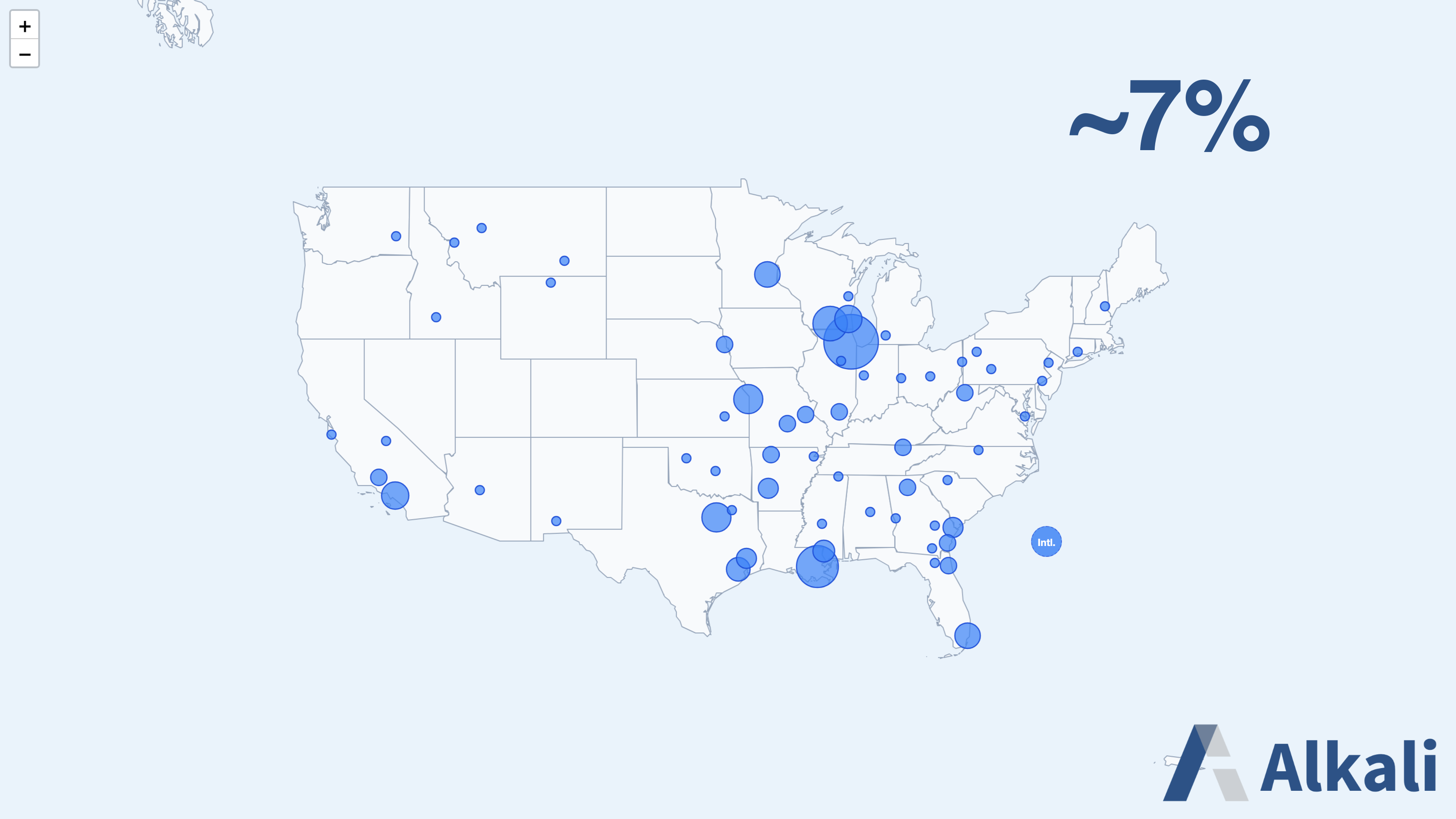
Map of projects estimated on Alkali in April. Circle area is proportional to number of projects. Projects constitute approximately 7% of the U.S. structural steel fabricated monthly [1]. Project locations anonymized [2].
Driving back from NASCC 2026
We just got back from the NASCC, and we had a blast. We made new friends, showed Alkali to a lot of new people, came home with a long list of product ideas, and even saw a whale shark.
Afterwards, our team had a lot of time to reflect on the thirteen hour drive back to Houston.
It was early last year we showed the first Alkali prototypes to Houston steel fabricators. At the time, we weren't sure how quickly the steel industry would adopt this new AI technology for estimating. Almost a year after publishing Alkali, we have some initial conclusions.
Early Alkali Usage
We made Alkali public last year. In each month since, project volume has more than doubled the previous month. In April, Alkali was used to estimate hundreds of new projects. The map above shows an anonymized subset of projects estimated last month on the platform.
On one hand, the rate of Alkali adoption is pretty exciting – it has been faster than expected. It's exciting to wake up in the morning, and see 10 new projects being estimated on the platform, before I get to my own computer.
On the other hand, the map looks pretty empty in many regions. Project locations are anonymized, but you get the gist [2]. While hundreds of monthly steel projects is great, ConstructConnect publishes about 60,000 projects each month across all construction divisions.
We still have a long way to go. But we're starting to see the same project being uploaded multiple times from different customers, so coverage is converging.
We talked to 350+ steel fabricators this last year. Here are the reasons why Alkali is being quickly adopted:
- Speed – For large projects, material takeoff is just much faster. This usually translates to more bids. Alkali automatically gets beam lengths, stud counts, camber, and copes for hundreds or thousands of beams. Check out our Baltimore speed run video, it takes 15 min to take off >350 tons of steel.
- Project Screening - Load a project into Alkali in ~30 seconds, and check if the project is interesting to you. Don't waste time bidding on irrelevant projects.
- Easy to Use - A fabricator called it the Tesla of estimating. We also got a team using it that didn't even have a computer at the time.
- Catch Details - Alkali helps make sure you take off the right-sized baseplates, and don't miss the hoist beam in the elevator.
Comparison to the US Market
The AISC published statistics a few years back on the state of structural steel fabrication in America [3].
This month, Alkali users took off more than 25,000 tons of steel (i.e. 50,000,000 lbs), mostly using artificial intelligence. That works out to be ~7% of the average monthly U.S. structural steel volume [1].
On a project-count basis, the picture looks slightly better. The AISC says U.S. structural steel supports more than 8,000 projects each year; Compared to a rough monthly average, Alkali is already seeing a double-digit share of that project flow.
These numbers are a fun milestone for the company, but it's obviously early days. It's still very rare for two shops to be bidding on the same project.
It seems likely that eventually, a centralized system (i.e. Alkali) will have an estimate for a project before a fabricator even starts bidding it. The system will customize labor rates to your historical jobs. But every time, you will have your estimator(s) check, review, and edit.
Conclusions
It's still hard to imagine blindly relying on AI to handle something as business-critical as pricing projects.
But AI systems are now safely deployed on tasks as life-critical as driving vehicles [4]. Although the task is life-critical, if systems have seen millions of highway driving miles, they can safely take over these straightforward parts of driving. And for these tasks, they can be safer than humans.
If automated systems can handle the important but boring stuff, it frees up estimators work on the harder parts (i.e. section cuts), bid on more projects, and spend less time playing pick-up sticks.
Notes
[1] The 7% callout compares the 25,000+ tons of steel taken off in Alkali during April with an estimated average month of U.S. structural steel volume. We estimate the monthly U.S. figure by taking AISC's annual structural steel benchmark and dividing by 12. That is a significant approximation: steel demand is seasonal, project mix changes month to month, and the AISC figure itself is a rounded industry benchmark.
[2] For anonymization, nearby projects are merged into regional clusters. Small clusters are shifted hundreds of miles from the underlying proposed project locations. Plot shows a representative subset of data.
[3] The AISC number is useful because it is about structural steel, not rebar or total raw steel production. If you know of a better current source for U.S. fabricated structural steel tonnage, please send it over.
[4] According to a 2024 Waymo safety report.